Categories
BLOG - Risk For Competitive Advantage Events Uncategorized

Is Your Free Trade Zone a Channel for Counterfeit Goods?

Is it time to take a closer look at another potential risk in your global supply chains and trade policies?  Industrial manufacturing and apparel and clothing are a few of the many industries that utilize Free Trade Zones and as a result, maybe unknowingly exposing their supply chains and business to a greater risk of the introduction of counterfeit goods.

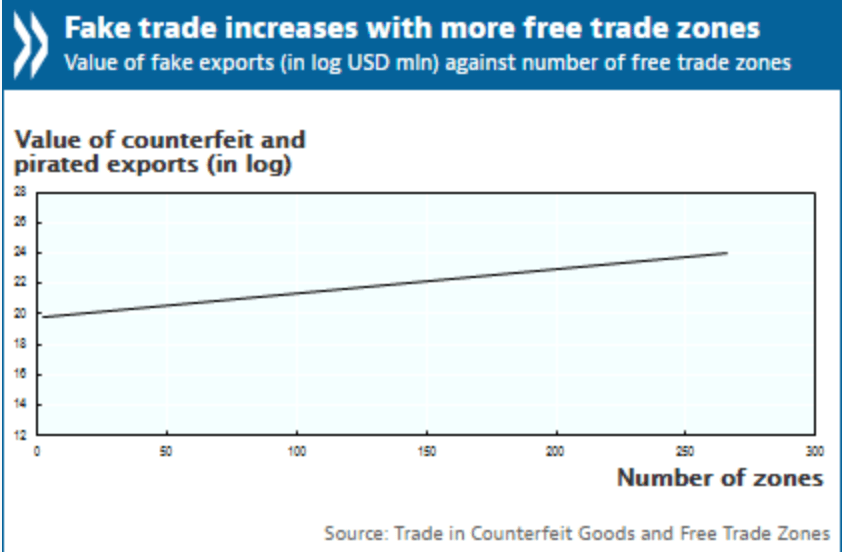
Recently published research by the OECD (Organisation for Economic Development) and EU Intellectual Property Office revealed a 5.9% rise in the counterfeit exports and the establishing a new Free Trade Zone.

The OECD reportTrade in Counterfeit Goods and Free Trade Zones, concluded that “exports of counterfeit and pirated goods from a country or economy rise in parallel with the number and size of free trade zones it hosts. Comparing growth in free trade zones, measured by the number of firms and employees in the zone, and customs seizure data from around the world shows that establishing a new free trade zone is associated with a 5.9% rise in the value of counterfeit exports from the host economy.”

The number of free trade zones is up from 79 located across 25 countries in 1975 to more than 3,500 located in more than 130 countries today.

What is a Free or Foreign Trade Zone?

Free-trade zone, also called foreign-trade zone, formerly free port, is an area within which goods may be landed, handled, manufactured or reconfigured, and reexported without the intervention of the customs authorities. Only when the goods are moved to consumers within the country in which the zone is located do they become subject to the prevailing customs duties. Free-trade zones are organized around major seaports, international airports, and national frontiers—areas with many geographic advantages for trade (Source:  Encyclopedia Britannica).


Categories
BLOG - Risk For Competitive Advantage Uncategorized

Navigating Uncertainty, Managing Risk: China’s Cobalt Play and the Future of Battery Capacity

China secures 30% of Glencore’s output of Cobalt. With autos competing for material, what capacity remains for everyone else in the automotive and mobile battery supply chains?   See my prior post:  Apple’s Cobalt Play

IndustryWeek

China Leaving West Behind in Race for Electric-Car Raw Materials


Categories
BLOG - Risk For Competitive Advantage Uncategorized

Apple’s Cobalt Play: A Lesson in Competitive Strategy, Navigating Uncertainty and Securing the Supply Chain

Another Apple Trifecta?   If recent reports of Apple being engaged in discussions with cobalt suppliers are true (and I bet they are) then we are about to witness another  lesson in how to gain competitive advantage as Apple simultaneously executes competitive strategy, uncertainty navigation and supply chain risk management.

Competitive Strategy

CEOs and strategists often define competitive strategy as a point-of-view about the future in which they execute against.  To do so requires focus, unique value and achieving superior returns on capital investment.  One of Michael Porter’s key principles to competitive strategy is that one must thoroughly understand the industry value chain and the value creating and cost generating activities associated with it.   Note:  competitive advantage is achieved at the activity level or in this example, the supply chain resources, technology and processes.

Apple’s leadership has achieved competitive advantage over the past decade by consistently and thoroughly understanding the industry value chain as well as their own product supply chains and related sourcing activities.   As a result, uncertainty surrounding these activities has been greatly reduced thus allowing faster and bolder investment decisions.  The sourcing activity has clearly provided Apple with unique and sustainable value.  Decision making about the future of essential materials, such as Cobalt, are viewed simultaneously through a market and operational lens, then linked to financial performance.

For example, in 2011, Tim Cook revealed that he had entered into long term component supply contracts worth $3.9 billion over the next two years. Apple had locked up 60 percent of the world’s touch panel capacity, creating an industry-wide shortage and making it hard, if not impossible, for competition to release new products or keep the shelves filled. Not the first time, or the last, Apple leveraged its deep insight into the market, strategic suppliers and “timing” opportunities throughout its materials-to-customer supply chain to separate themselves from the competition. They exercised similar prowess with batteries, NAND flash memory, LCDs glass for iPad retina display, memory chips, image sensors, and the special resins that are used to hold chipsets together. Events like these delay competitors from coming to market or keeping inventory on the shelves.  (excerpt From: Gary S. Lynch. “Uncertainty Advantage.” iBooks. https://itunes.apple.com/us/book/uncertainty-advantage/id1196773501?mt=11).

Navigating Uncertainty and Managing Risk in the Supply  Chain

As EVs (Electric Vehicles) and energy storage become more widely adopted the  lithium ion cathode battery demand and use of cobalt will shift from mobile devices to mega-industry equipment for transportation and energy.   Cobalt is an essential material in the production of the lithium ion cathode and Apple’s leadership certainly understands the potential risk.  More importantly, their view is not limited to their primary industry value chain but also competing and adjacent value chain (another Porter principle, competing for profits and understanding the five forces).

Apple once again is aggressively navigating uncertainty, clearing the obstacles ahead as the proceed down the highway.  To do so not only requires a willingness to take risk but also a commitment to gain deep insight into the broader industry value chains, the activities that differentiate their products and the competitiveness for key commodities and capacities.

Now the elephant in the room, do organizations in the healthcare, food and other industries exercise similar rigor?  Are they prepared for a potential large-scale shift in capacity or cost?    Will organizations in these industries be able to compete for supply with the mega-energy and automotive industries?  A shortage of radio-isotopes in 2009 should have been a wakeup call to the industry and strategic planners that a broader view of industry value chains that support their products and services would be needed.   It that case it was the failure of a major producer.  Now these industries are faced with a similar threat because cobalt is used in many products including:  external beam radiotherapy, sterilization of medical supplies and medical waste, and radiation treatment of foods for sterilization (cold pasteurization) – (Wilkinson, V. M; Gould, G (1998). Food irradiation: a reference guide. p. 53. ISBN 978-1-85573-359-6)

 Bottom line:  Apple continues to demonstrate the opportunity to leverage uncertainty for competitive advantage.  To do so requires relentless pursuit of the data and details while simultaneously understanding the competitive landscape both within and outside your industry.

Categories
BLOG - Risk For Competitive Advantage Uncategorized

Toyota navigates uncertainty, manages risk by design

Interesting article from CNBC that reflects how risk is being considered as part of the design and innovation activity.

Toyota is trying to make electrified vehicles less dependent on Chinese minerals

Toyota is navigating uncertainty and managing risk by design.   As a result, Toyota may be able to minimize customer/dealer delivery disruptions of it EVs (electric vehicles) arising from changing trade policies, higher sourcing cost, and/ or geo- socio-political- events (e.g. tariffs, taxes, political posturing, war).

Bottom Line:  I don’t believe this is an isolated case but rather it reflects the early stages of an emerging trend.  Personally, I’ve recently received a number of calls from Supply Chain and Operations Executives who are seeking greater insight and risk related data.  As the discussion evolves, it is clear that their intent is to gather this data for competitive differentiation rather than defensive investment. 

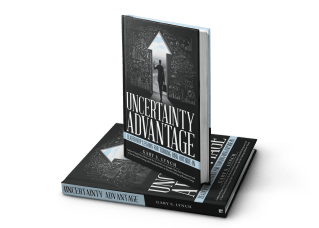
I’ve included several examples in my recent publication, “Uncertainty Advantage:  Leadership Lessons for Turning Risk Outside-In” including an excellent example of how Rockwell Automation incrementally improved their risk and resilience investments from defensive to offensive weapons (Chapter 7, pages 242 – 244).

UA 3D 1 on 1 to Left


Categories
BLOG - Risk For Competitive Advantage Uncategorized

KFC Chicken Shortage Reveals Limitations of Current Resilience Strategies

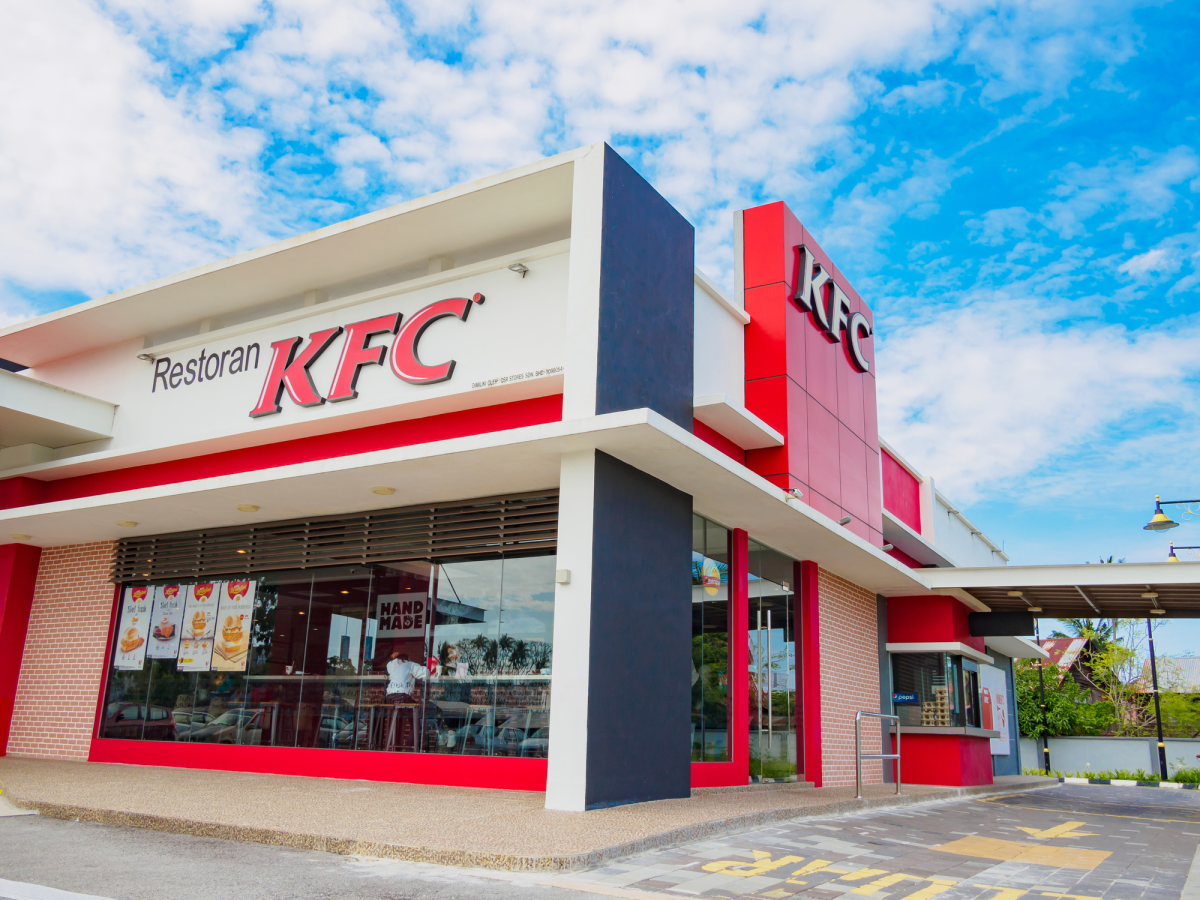
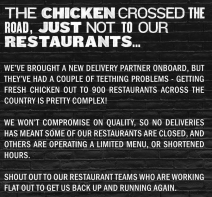
CNBC recently reported that up to 900 KFC branches in the UK faced a chicken shortage due to issues related to switching to a new delivery partner, DHL.

Screen Shot 2018-02-19 at 8.27.50 PM

Source: CNBC

Organizations mitigate supply chain inventory disruptions through a variety of strategies including:

  • Stock redundancy (safety stock)
  • Stock diversification
  • Direct ship
  • Alternate sourcing
  • Inventory substitution or repurpose
  • Increase inventory investment within a channel
  • Segmentation and prioritization (allocation)
  • Salvage or repackage

However, these strategies in combination with the organization’s risk and resilience programs are typically limited to operational activities.   Business continuity, crisis management, and supply chain risk programs seldom link to market intelligence and the financial rigor needed to exploit uncertainty at the onset of a disruptive event.

No chicken, no customers?   Should that be the organization’s assumption when the core product or organization’s unique value evaporates?   Or does this single point of failure actually represent a single point of opportunity?   For example, from a market or industry perspective does the disruption represent an opportunity to accelerate the acquisition of a competitor or alternative product that will eventually lead to a broader, more appealing menu?  Is this disruption an excuse to exit an unprofitable business in favor of a more promising opportunity?  Or in the case of KFC, does a brief shortage represent an opportunity to promote a different set of products on their menu at a deep discount (or for free)?  What did KFCs competitors do to exploit the opportunity, did their playbook include a strategy for exploiting this type of market disruption (i.e. the failure of a competitor)?   The following case is provided to illustrate how GM outflanked Toyota when presented a significant recall.

Bottom line:  organizational risk management fails as a strategic weapon because it ignores the most pivotal facts of the business landscape – the market and financial objectives.   Markets move fast, organizations do not.  Supply chain resilience programs are the starting point, however, these programs must be linked with broader contingency/opportunity strategy that includes the market and financial performance.


NEWS AFTER THE ORIGINAL POST

550 outlets remain closed


A case in point is a comparison between GM and Toyota in 2014. GM recalled 29 million cars worldwide in 2014, following thirteen deaths and fifty-four crashes due to a faulty ignition switch. Chevrolet Cobalt models were the culprits. The way GM handled this is instructive in comparison to the Toyota response in 2009– 2010 when acceleration problems led to recalls. In the case of Toyota, an attempt to diffuse the situation through public relations— including a denial that the problem even existed— nearly destroyed the company. The Toyota error was instructive to GM, and it reacted in a very different way. The GM focus was not on the profits impact but on markets.  

As a result, sales and profits rose after the recalls, when you would naturally expect them to fall. Why? Jessica Caldwell, a senior analyst with Edmunds, explained, “You’d think it would damage their brand, but it’s actually helping to drive purchases at the dealerships.” Recalls brought people into the dealerships, of course. But GM saw this as an opportunity and focused its energies there. In July 2014, GM posted its best monthly sales in seven years despite the massive round of recalls. They sold over 256,000 cars that month alone, a 9 percent uptick from one year before. The consumer visits to the dealership as part of the recall sparked more trade-in activity that would have occurred without the recall. GM offered attractive low-cost financing coupled with employee-level pricing, a 34 percent discount from retail price.

SOURCE:  Gary S. Lynch. Uncertainty Advantage: Leadership Lessons for Turning Risk Outside-In (Kindle Locations 1703-1709). Archway Publishing. Kindle Edition